Showing posts with label Fiction. Show all posts

Sunday, June 1

Tardy

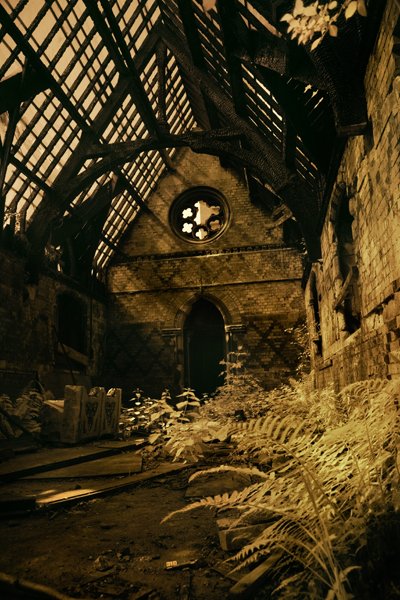
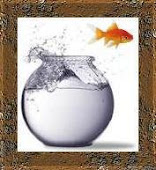
I was inspired to write something about this photo presented by Wordsmiths Unlimited in February. At the time, I was too busy, lazy, and tired to contribute. I had the idea for a prayer, which I now present much too late, much too short, much too contrived, and blasphemous in between.

This is a work of fiction. Copyright © 2008 Bolt, Ink.
All Rights Reserved.
No portion of this work may be copied, retransmitted,
reposted, duplicated, or otherwise used without
the express written approval of the author.


Prayer of Sacrilege

Mother Mary, Full of Grace
Hear my plea
I too am young in life and love
Am I ignored in my sighs?

Mother Mary, Full of Hope
See my tears
I too have no place to call home
Am I alone in my cries?

Mother Mary, Full of Truth
Feel my rage
I too am conceived without husband
Am I unworthy in Heavenly eyes?

Mother Mary Full of Lies
We are the same between our thighs

Wednesday, January 30

The Blood Of Ravnius

This is for the first Wordsmiths challenge of 2008. Please join us this year!

This is a work of fiction. Copyright © 2008 Bolt, Ink. All Rights Reserved.
No portion of this work may be copied, retransmitted, reposted, duplicated,
or otherwise used without the express written approval of the author.


The Blood of Ravnius


“Our enemies will cower at our name!” Ravnius cast his voice over us, a glory and a promise to a downtrodden people. “Ride behind my banner! We shall read the future in their blood!” All of us, soldier, hunter, herder, slave, raised our fists to the sky, shouted our daring to the heavens.

After the acclamations it fell to we four advisors to consult on strategy and tactics. We finished in two days. In our zeal the preparations for armaments and supplies were complete in three. On the morning after a feastday, Ravnius rode under his red and gold pennants, before a bristling forest of spears, pikes, and scythes, an army large enough to terrify the gods.

At Trest, the first battle, our determination crashed upon the enemy like a hundred oceans. Their superior numbers were no match for our rage. The plains were streams of blood, over which Ravnius proclaimed “See! See the future! Blood does not lie!”

At the Battle of Mount Senneth the enemy’s halls burned as a crowd of survivors fled. It was less satisfying, the victory more easily won. Advisor Thorki said he had seen the future in blood, a future unrecognizable, filled with absurd figures in strange clothes, riding their mounts backwards.

At the Battle of Hotsk children wailed at their parents’ deaths before meeting their own. Advisor Velnnen commented on the trees growing in ponds of red. In the reflections he claimed he saw the ghosts of the slain hung by their own torn garments, swaying in the branches, gaping yet silent.

At the Battle of Pon-ju-rabsi there were few to vanquish, tales of our conquests spreading like a plague on the wind. We killed without joy, plundered nearly empty vaults without greed. Advisor Baln would not sleep, his sight filled with scarlet mists that roiled and moaned but whose voices meant nothing.

After the fight, if such it could be called, at Jianng, I tried to divine the future in crimson pools. No visions came. I saw only submerged and broken pots of the marketplace, drowned embers of household fires, splintered tools of farmer and smith. I watched crows patrol the bloody shore, gleaning shreds of flesh and bits of bone. In them I finally did see a future told in blood.

That night the four advisors, Thorki, Velnnen, Baln and I, convened around our campfire. The decision was quick and final. We strode to the great tent and threw the covers open.

“What brings you here?” Ravnius demanded.

“You have lied to yourself and to your people,” said Thorki.

“This ceaseless killing can serve no purpose,” said Velnnen.

“The gods turn their faces in shame,” said Baln.

“What! We are history’s mightiest victors! Our deeds will echo through the ages!” Ravnius glared with flat black eyes. We remained still. “Are you warriors? Or have you cowards nothing to say?” Flanked by my comrades at arms, I advanced, raised my sword, and spat his words in his face.

“Blood does not lie.”


Tuesday, November 27

Listen Close

This is a work of fiction. Copyright © 2007 Bolt, Ink. All Rights Reserved.
No portion of this work may be copied, retransmitted, reposted, duplicated,
or otherwise used without the express written approval of the author.


Listen Close


That fucker, he’s always watching.

Doctor LaSalle the pusface tries to tell me what’s right, but she’s a philistine. She never listens. She talks and talks but never expresses a coherent thought. How many times do I have to point out the obvious?

Fluoxetine? Please. I eat that shit like candy. Lithium? Might as well swallow the powdered exhaust from a ‘57 Ford. That stuff’ll kill you for sure. Haloperidol? Might work on an earthworm, but not a crocodile like me. Clozapine? Ain’t gonna do it, hombre. I hide it in my corn. Can’t trust corn either. Kernels or pills, what’s the difference? They will both kill you if you aren’t careful.

No one learns any more, that’s the problem. No one really reads a book or feels the hum of the planets or thinks in the darkest safety of the night. There is everything there, more than your mind can hold. But not me. I keep my mind pure and alert and open to everything. That’s why I am free. Intelligence is not bound by ideas others have thought before. You’ve got to go and make reality for yourself.

Listen close: Toccata and Fugue in D minor. Cleopatra’s Needles. The Rubaiyat of Omar Khayyam. Lawrence Welk. Aluminum nitrate. Jesus turding Christ! It’s all right there! One day they’ll stop cleaning these walls and look at the stuff I’ve written there. Then they’ll see.

The New York Times, Il Papa, Commandant Pusface, my father. They all think they know, but they don’t. They think I don’t know, but I do. I KNOW. I know i know i know i know i know. It’s that knowledge that keeps me safe.

If you’re smart, you’ll listen, and listen close. Pay attention. Beware. Don’t trust anything. Don’t trust anybody.

Because that fucker? He’s always watching.


Thursday, November 1

Exchange Rate

This is a work of fiction. Copyright © 2007 Bolt, Ink. All Rights Reserved.
No portion of this work may be copied, retransmitted, reposted, duplicated,
or otherwise used without the express written approval of the author.


Exchange Rate


¡Sangre de Cristo!” Villareal almost tripped over his mop in his haste to leave the room. He crossed himself twice, intricate tattoos emblazoned on his forearms, the left a glowing Virgin Mary, the right a somber crucifix.

“What’s wrong?” I asked.

Ladrón de almas: the thief of souls!” The mummy I was studying, had been studying for a week, stared without eyes. I forgot Villareal was rarely down in the basement, so had never seen our current project.

“Oh, him? He was found in the mountains east of town. He can’t hurt anyone now.” Villereal crossed himself again, grabbed his tools, and fled up the stairs.

I spent the day examining the body and taking notes. The forgotten town in the arid Mexican hills had yielded a wealth of treasures from the nineteenth century, including 23 mummies. For some reason we could not determine, all had been found unburied in a cave, unusual for the time and place in which they had lived. Some were found with thick paper cards embellished in strong, flowing Latin script. Such was the case with Castro, our current project, so named for his card. We called them “inventory tags,” a ghoulish joke that no doubt would have offended our poor beloved janitor.

After bending over the table and peering through magnifying lenses all day, I was ready for a hot meal, a cold drink, and lively music at the cantina. Villareal met me at the top of the stairs.

“Please jefe,” he pleaded, “do not leave me here alone.”

“There is nothing to be afraid of, my friend. Nothing can hurt you here.” I laid a reassuring hand on his shoulder. “Besides, the night crew will be here soon. Buenos noches.” I left the building, feeling guilty in the frightened gaze of the superstitious Villareal.

The next morning, the janitor greeted me as I opened the museum’s heavy doors. I didn’t recognize him.

“Where is Villareal this morning?” I asked.

Buenos dias, señora. He is not here. I take his place.” A glance at his nametag betrayed his lie. It said Castro. An expanding pool of sickness threatened to rise from my gut. I ran down the stairs to the basement lab. The corpse was still on the examining table, covered in the same dingy cloth.

“You look like you’ve seen a ghost,” my assistant said. “We got another one today.” He pulled back the cloth to reveal a dried, papery face. The features were a grotesque contortion, as if the person had been frozen in panic at the moment of death. “Looks like the night guys moved ol’ Castro.”

My skin went numb. My bones turned cold. My eyes turned the room into stark colors and lines, dark and menacing. I pulled the cloth farther. There, on the parchment-like skin of mummified arms, were the faded representations of the Blessed Virgin and her Son.

I didn’t need to see the old inventory tag to know what it read now.


Sunday, September 30

Stars Of Fear, Skies Of Hope

“Mama?” The only reply was the rhythmic metallic squeaking of an electric fan. Sarah set her schoolbooks on the dinette table, knocked over a vase of plastic flowers. “Mama?” she repeated, not without a little fear.

The tiny kitchen was as she had left it this morning: breakfast bowl and juice glass in the sink, cherry print tea towel draped over the faucet to dry. She made her way to the back of their home, through the cramped living room where she slept, down the narrow hallway past the bathroom with immaculate linoleum tile. She paused in the doorway to the bedroom, praying for sound. It was only after she heard a papery sough of breath that she realized she was holding her own.

“Mama? Are you awake?” The woman on the bed didn’t respond. Her chest rose and fell like an irregular tide, an ebbing and flowing of life. Sarah crept to the side of the bed, felt a damp cheek. Her mother stirred and opened her eyes. For a moment there was nothing, then: “Sarah, child.” A weak smile.

“How are you? Do you need anything?”

“Just make me some nettle tea. Then I will be fine.” The eyes closed.

“It doesn’t help, Mama. But don’t worry. If we can’t pay the doctor my friends will help.” There was no response. “Mama?” Silence except for a stuttering breath.

The mixing bowl next to the bed was dirty again. Sarah dumped the blood and sputum in the toilet, rinsed the bowl in the tub, and placed it back on the nightstand. She shut the windows halfway against the coming night’s chill. In the doorway she watched the chintz curtain’s lively flutter, watched the thin quilt’s quaking rise and fall.

She prepared for the evening. She made herself dinner of macaroni and cheese, washed the dishes, setting them to dry in the wooden rack. She did her homework at the dinette table, putting the flower vase in it proper place when she had finished. Toward sunset she laid out her clothes for school, scooped up a blanket from the sofa, and went outside, careful not to slam the screen door.

She unfolded a lawn chair and hugged the blanket close The wait would be long. The sycamore leaves were trimmed in yellow, swaying in the cool breath of approaching autumn. To the north, stars presented themselves in purple velvet twilight. Sarah stared at them, only a little afraid now. They always came from the north. In her mind she pictured her friends floating down from the sky, bringing miracles and hope with them. They would come. They had to.

Saturday, September 29

The Weave Of Esteem

This is a work of fiction. Copyright © 2007 Bolt, Ink. All Rights Reserved.
No portion of this work may be copied, retransmitted, reposted, duplicated,
or otherwise used without the express written approval of the author.


The Weave of Esteem


Meeting the boss every Tuesday was like lying on a blanket infested with fleas. Richard sat in an uncomfortable trendy chair. Across the desk Drew scrabbled on a tablet with a gold pen. The computer screen beside him glowed, awaiting use. It would glow and wait all day, because the boss had a secretary. Richard waited, patience wrestling with the desire to be elsewhere. After a few minutes, the boss folded his hands on the exotic wood, showing the sleeves of his tailored and pressed shirt. Silver cufflinks winked in a shaft of sunlight.

“I don’t have anything this week. Whatcha got?”

“I called the Temecula office. No one in town will extend credit to Wagner Promotions.”

“Yeah, I heard about that. The manager there was pretty pissed at you. He said the client was insulted by your phone message.” Richard stared, determined not to show any trace of insecurity.

“I decided based solely on the facts. I already said no to the account executive and the sales rep. Wagner still wouldn’t accept it, so I explained my reasons.”

“A sales guy like me and the rep would have handled it different. But that’s how you accounting guys are, and you do it well. I support your decision. I’ll handle damage control. What else?” Humility burned Richard’s skin. Drew’s monogrammed collar burned his sight.

“I thought about your advice over the weekend. I don’t like the way Bill treated me, but I don’t want to damage our relationship. I’ll let it go.”

“You might have screwed up on that one. You could have called him on it. But I support your decision. Anything else?”

“No.” The meeting was over.

“Wait.” Drew tossed a pale blue rectangle. Richard caught it, recognized a finely woven dress shirt, company logo embroidered over the breast pocket.

“That should look better with your tie.” Richard thanked his boss and withdrew.

The evening commute was punctuated by an accident, a construction zone, and aggravation. The feeling didn’t diminish when he arrived at the rental he called home since he moved into town. He undressed, news mumbling on the television and dinner sissing in the microwave.

He stared in the mirror. It was a nice tie, colorful yet understated. The haircut was decent, if inexpensive. The shirt had a coarse weave, but it kept him warm under the air conditioning vent in his office. A bare light bulb glared, highlighted his efforts as cheap imitations. He unbundled Drew’s gift and put it on.

The tie did look better. Everything about him looked better. He removed the shirt, trying to reconcile worth with shame. The top button popped, bounced off the mirror, and hit him in the eye. Anger filled his arms, ripping the shirt from his chest. In seconds the offense lay in shreds at his feet.

Questions would come, but Richard would never explain. His shirts might come from JC Penney, but he was still the best damned accountant Drew would ever see.

Tuesday, August 14

The Pull Forward

On the first night without her the moon was hidden. It slipped into the darkness that covers us all. It showed itself later, swollen and dull, ignoring the laments of the world below. Last night it was a hungry crescent, a weak promise of return. The changing moods of the moon remind me of what I do not want to believe. Ruthie is dead.

My sadness refuses to fade despite the daily care and kindness of visitors. My friend Samuel, anticipating simple things I didn’t know myself, bought me new shoes. He took me for walks over fields, beside the stream, under the comforting canopy of the apple orchard, saying nothing, requiring nothing in return. Other friends brought me chocolates, trying to lure my thoughts away from myself and the grief that threatened to swallow me. I accepted their gifts without grace, gratitude overwhelmed by a sense of loss.

This morning, as Ruthie used to do, I stand by the fence to watch the day unfold. Beyond are the scents of new mown hay, the flicker of bluebird wings, and the clanking cow bells of my farm. Samuel pokes me in the ribs. It startles me with its rudeness. I want to kick him, but he is insistent. Wallowing is over, he seems to say. Work awaits.


We hitch up the wagon and begin our familiar route. At the green house we deliver two quarts of milk. We deliver a half-pound of butter at the blue house. The brown house wants nothing. The grey house is the liveliest one on the street, its sagging porch filled with the laughter of boys. It needs four gallons of milk, two dozen eggs, a pint of cream, a pound of butter, and a gallon of ice cream.

“Hi, George!” Alex hollers out to me. He throws a ball to Samuel, with the obvious expectation of it not being returned. I have never seen Alex without a ball in his hand. He is always in motion, always shouting or laughing. My world has changed, but his has not. I nod my head in his direction.

Alex runs to me and pats my shoulder, then runs across the street, falling into a tumble of other boys on the lawn. Tonight they will sleep the exhaustion of innocence spent under a summer sun. Tonight the deliveries of Samuel and I will fuel the escapades of their tomorrow. Tonight the moon, reveling in the sweetness of caprice and new mown hay, will shine bright with promise. Ruthie is gone, but my work is here. It will fill the empty spaces between questions until answers can be found.

I set my hooves to the street and pull the wagon forward.

Sunday, July 29

Shutting Down

-blink-

A grid flashes across his vision.

-blink-

The afterimage lingers like the ghost of an executioner. It fades from sight, replaced by the teasing blue sun sparkles of Hanauma Bay.

“Honey? Are you okay?” He shakes his head, aware now that the blip in his sensory perception had affected his hearing as well. He turns to her and pats her hand.

“Yes. Just a little pause in the implant. Nothing to worry about.” He smiles. She smiles back, shining brighter than the Hawaiian sea. She reaches across the arm of his beach chair and kisses him.

“Go slow. The doctor said not to push yourself.” She smells of salt, coconut oil, perspiration, and the singular scent of a woman who has agreed to be his for a quarter of a century. She pushes his hair back with a small hand. The butterfly sweetness of the touch arouses a primal feeling of possession, wonder, and contentment.

“Really. It is nothing. Shall we go snorkeling?” he says. Before he can stand, she grabs his mask with an impish grin and runs to the gentle surf. Puffs of sand play tag in her wake in apparent delight of her beauty. With a chuckling sigh, he picks up her mask and follows.

Despite the tropical warmth, the water stings. It infuses him with its vigor, charging his very bones with life and desire. Donning the snorkeling gear, he plunges headlong into the life and death world of the reef. It doesn’t take long before he is surrounded by swirling, glinting clouds of fish, grey and purple and yellow and blue. Next to him she floats like a mermaid. He reaches for her hand, feels the laugh of the young girl he knew vibrating in her fingertips.

-blink-

The fish dissolve into a mass of nonsensical shapes.

-blink-

She becomes a blur of conflicting colors.

-blink-

The grid appears again. In its unnatural regularity he sees a mocking smile, hears an empty laugh, feels an icy uncaring of all ending.

It is as the physicians had warned. Despite all the knowledge, all the skill, and all the miracles, chance would play its final card. The languishing disease would win, slowly at first, but with inexorable stealth. The technological marvel of the implant that promised to keep his brain connected to the rest of him would fail. In bytes and pieces he would lapse into a mind trapped in an unresponsive shell.

-blink-

He treads water. She holds his hands, pulls him close, and throws her face to the sky, giggling and precious.

He blinks, capturing a picture he will hold, and hold, and hold tighter, and never let go.

Saturday, July 28

Score Bored

Challenge courtesy of Wordsmiths Unlimited.

This is a work of fiction. Copyright © 2007 Bolt, Ink. All Rights Reserved.
No portion of this work may be copied, retransmitted, reposted, duplicated,
or otherwise used without the express written approval of the author.

Score Bored

“God damn it!” Eddie had cursed both the offending scoreboard and me in the same breath. “This is the second time! San Antonio is in town again. I’ll never live it down. Fix the fucking thing or find a new job!”

I stand at the pitcher’s mound. Looming over center field is a $100,000 hunk of technology that refuses to work. No numbers, no letters, no nothing, just a matrix of squares flashing multicolored jibberish. Every random twinkle is a dart in my confidence, a refutation of my assurances that Boulder Field is now part of the twenty-first century. Eddie, the owner of our minor league Mountaineers, is furious. I can’t blame him.

Beside me Gus the groundskeeper spits. His expectoration describes a glistening arc under the late spring sun, ending with a muffled splat on the grass near first base. “It was better when we turned the score tiles by hand,” he says.

“Maybe,” I say. “But Eddie will have my head if I don’t fix this before the Generals game.” Gus spits again.

“Screw the Generals. Nuthin’ good ever came outta San Antonio. Eddie can suck my balls.” Gus folds his thin creaking frame behind the wheel of his handyman’s golf cart. The wheels leave barely perceptible tracks in the diamond’s clay. Tools clatter in the handmade wooden totes.

I have checked every wire and every bulb. I have discussed problems of timing, compatibility, and reliability with our vendors. I have made lists of connections and fuses and transformers. I run them all through my mind. I must have missed something, but standing in the middle of Boulder Field brings no answers.

I hike the stairs to my office. The bunker-like quality of concrete and overhead conduits always makes me smile. The fans know the grand green view and hot dog smells of the stands. They would never guess the bland and boring everydayness of operations. It is part of my job to perpetuate that illusion.

In my office I check the scoreboard software for the hundredth time and find nothing again. After two hours of pondering, my stomach reminds me it is time to eat. I munch a bland sandwich in the employee lounge. It is located high above third plate, affording a view of the entire stadium. I watch the sprinklers make their familiar chk-chk-chk sound as they water the outfield. The answer hits me like a bump to the funny bone, both painful and obvious, and I laugh out loud.

I will talk to Gus, the old cuss, and tell him I know about his irrigation patterns. I will talk to Eddie, the owner, and describe the solution. Gus will keep his job, Eddie will keep his pride, and I will keep my reputation. We will all win.

Go Mountaineers!

Wednesday, June 13

The Return

Wordsmiths Unlimited is back. Please visit and contribute. You never know what wonderful thing might jump out of your head until you try. Our first assignment isn't due until June 30, but I just had to get this one out of the way so I can concentrate on my next piece(s).

I found this one quite difficult. I don't like the result, although I would like to explore the theme further at some point. (I tried and rejected half a dozen titles. When I was finished I realized that "The Return" could also apply to Wordsmiths. Weird.) After too much tinkering it's best to put it down. Time either brings new ideas, or allows you to put it down in the veterinary sense.


This is a work of fiction. Copyright © 2007 Bolt, Ink. All Rights Reserved.
No portion of this work may be copied, retransmitted, reposted, duplicated,
or otherwise used without the express written approval of the author.


The Return


“Look, Mom! They’re hatching!” Manuel tugged at her grip.

“Hush, Manny. Stay close. Don’t interfere.”

“Why?”

“Remember what Abuelo says. We can’t help.”

Teresa looked down at the eager little boy clutching her hand, so much like Abuelo, her father. Both of them had the same childlike joy of wild places and wild creatures. She was between the two of them, taught by the elder, teaching the younger.

In her own youth, she had begged Papa to take her on his scheduled excursions to monitor the sea turtles. On successive nights they would sit in silence under a gravid yellow moon as female turtles emerged from the surf. They watched the clumsy mothers heave their tired bodies beyond the tide line. Limbs used for swimming were employed in moving sand against unfamiliar gravity. With grunts and eyes dull from arduous labor the females deposited eggs in shallow pits and gently covered them, their maternal duty done. Papa told her that in the ocean they were friendly and graceful. She tried to imagine them under water, free and happy, as she watched them lumber back to the sea.

“Look, Teresa.” Papa whispered. “Look carefully. This is where the beach of the turtles meets the land of our people. We are their brothers and sisters.” Papa said many others had worked hard to make Playa de las Tortugas a refuge, a place where hotels and nightclubs were forbidden. Because of him, she and everyone who visited could witness the return of the sea turtles answering their ancestral call.

In the days following she felt she would burst from waiting. She pestered Papa with questions of how and when. She would ask “Today?” and he would reply “Perhaps.” Weeks after the nesting, on a summer day of wide skies and glistening sands, she and Papa ambled beneath the tropical sun. Waves had long since erased the zig-zag trails of the nesting mothers. Teresa squeezed Papa’s hand, full of wonder and anticipation.

“Are they going to hatch?” she asked Papa.

Si. Stay still. Let them be.”

Teresa obeyed. By dozens, then hundreds, turtle hatchlings tottered toward the ocean. She watched one wriggle from the sand and pause blinking against the new sun. After a brief rest it wobbled with alternating sweeps of its flippers toward the surf. Before it could reach home, a gull snatched it from the sand and swallowed it whole. The bird’s meal was quick and without mercy.

“Papa!”

“No, pequeña. It is the way of things.” Horrified, Teresa cried and hated her father.

Now, looking out on the brilliant deep blue, she thought of Papa’s gentle hand. She held Manny’s tiny fingers. A piece of her son was about to be lost to her, a piece of her lost to him. Abuelo would take possession of both.

“Go, little turtles!” Manuel squealed. She hoped he would not hate her for too long. She hoped he would return, like the turtles, to Playa de las Tortugas.


Friday, December 22

The Understanding Price

Try Wordsmiths Unlimited; it's fun. Case in point: this unusual and difficult challenge, including prologue and picture provided by Wordsmith Tiff. My cumbersome and pretentious drivel follows.


"A loud rapping at the door awoke me from a deep dreamy sleep. It was early, too early to be awake, and certainly too early to be out in the streets pounding on doors. I thought that there must be some emergency in town and ran to the door to find out whatever news there was from whoever was there. Much to my surprise, there was no-one at the door ready to identify themselves and their message, and yet a package with my name on it had been left at the door. It was a most curious circumstance, and yet I saw no real harm in it, because secret gift giving was the hallmark of the holiday season. I myself had delivered many a gift in that manner over the years. The package was heavier than it should have been from its size, and once I had it indoors I eagerly opened it to find out what it was and who had sent it. Alas, there was no identification of the giver, and more's the pity because what was inside was a most remarkable carved wood box, worked with figures of animals and dragons all over, in a magnificent shade of red. Whoever sent it to me must have been a prankster, though, because I could see no way into the box, no clasp or lock announced itself, no hinge or platen presented itself as a means to the inside. I was locked out, and most frustrated by this unfortunate turn of events."


This is a work of fiction. Copyright © 2006 Rumba Creative. All Rights Reserved.
No portion of this work may be copied, retransmitted, reposted, duplicated,
or otherwise used without the express written approval of the author.


The Understanding Price


Who would deliver something on Tuesday before sunrise? Angry from an unexpected awakening, I examined the ornate wooden box. Sinuous red dragons wound around its curves. It was beautiful, curious, the subtle and commanding work of a master craftsman, a puzzle requiring ingenuity to open. Why was it left on my doorstep? I had no time for further musing. A shower, coffee, and the commute demanded my attention.

The next day began with the familiar persistence of the alarm clock. I stumbled into the kitchen to make coffee, shaking sleep. The box was as I had left it, but now it was orange. Dragons were replaced by monkeys, tails linked, long limbs outstretched, reaching toward me. I attempted to find the manner of opening it, but failed again. Stumped, I prepared for another workday.

That evening I sat peering at the box, when a knock came at the door. My neighbor across the hall asked to borrow a screwdriver. I invited him in, asking his opinion of the mysterious treasure on the table. When we entered the kitchen the box was nowhere to be seen.

Thursday came, and the box returned. It was a deep brown. Intricate carvings of trees festooned its curves. Buttressed roots claimed the base, intertwined branches supported the top, like columns in a cathedral. After work, I inspected every crevice with a magnifying glass. For all my efforts the manner of its opening remained secret.

I refused to look at the box the next morning. Over dinner at night, I could not ignore that the box was now green. I held it in my hands, turning it over and over. A progression of bears sauntered in an upward spiral. Small at the bottom, each succeeding bear was a little larger than the last. The graceful parade terminated with one great standing bear stretched across the top, a silhouette of fierce confidence. What had I been given? What was this enigma that shifted its reality, teased me with its riddles? That night’s sleep was troubled by visions of birth, death, and the billion states in between.

Saturday morning dawned with me already awake. I stared at the blue box before me, not daring to touch it. Perhaps if I pondered and meditated and believed enough, I could open it with thought alone. A thousand fishes shimmered and swirled across the box, a hypnotic ballet that held me entranced. The day passed by. Life passed by. Transfixed, I watched the box, waiting for it to change.

Sunday. I raised my head from the table. I had fallen asleep. The box before me was now black. Its surface was an obsidian mirror, a dark anti-color opalescence. In the depths blood ran and spilled. Creatures rested and killed. Stars blazed and died. In a sudden cracking the box split in two, exuding a thin smoke, acrid and overwhelming.

Only then, at the precise moment of my expiration, did the box, and everything else, make perfect sense.

Saturday, December 2

Click Clack Snap


This is a work of fiction. Copyright © 2006 Rumba Creative. All Rights Reserved.
No portion of this work may be copied, retransmitted, reposted, duplicated,
or otherwise used without the express written approval of the author.


Click Clack Snap


“How come you never have what I want?” Click.

“How do I know what you need?” Clack.

“You never have enough blue ones.” Snap.

“Don’t blame me. I was bought this way. Maybe you should think harder.” Click-snap.

Stupid bricks. When I need a two-by-two, there’s only four-by-twos. When I need the triangle piece, all he gives me is a twelve-by-one, or a wheel. Dumb toy. The pieces never fit right. I want to stop playing, but I can’t.

“Do you have a small yellow brick?”

“You’re the one using me. Look for yourself.”

“I hate you.”

“You hate me because you aren’t smart enough to make me anything but a house.”

“Nuh-uh!”

“Yuh-huh! Look! What shape am I?”

I look. Rectangular base. Overlapping white brick walls. Clear two-by-ones like a window. The other pieces are jumbled up in little plastic boxes. Half of them are roof pieces. The rest are colors or shapes of bricks I can’t figure out how to use.

“See?” His voice makes fun of me, like every time. “I’m gonna be a house again.”

“Not this time. You always make me make you into a house. I’m not gonna use the door pieces, or the window pieces, or the tree pieces, or the little car.” Smashety-clack.

“Why are you undoing me?” Unsnap.

“You know you won’t me make me into anything good.” Brokety-toss.

“Now I’m just a big pile of dog doo. You’ll never make me into anything good.” I don’t talk. He made me mad. I’ll show him.

“What are you doing?” Click.

“What is this?” Clack.

“Are you done yet?” Snap snap. Done.

“What am I?”

“You’re an airport tower. See how tall you are? These stick out pieces are the warning lights. The top goes over the clouds so airplanes can see you.” I turn him around and around. For a while there is no rattling sound of plastic pieces being raked up.

“I look stupid.”

My mad makes me mad. He can’t beat me again! This time he will be most perfectest neatest thing ever!

Click snap clackety snap snap click clack snappety whomp!

“Wow. Look what you did.” Triumphant, I hold him in my hands. My disappointment and anger drip through my fingers.

He’s a house. Another stupid dumb poopy house.

“Don’t give up!” he says. “Look! This time you made the walls different colors! And the door is on the side! And the window looks into the basement! And the garage is on the roof! And you put the tree inside! Very creative! Good job!”

I turn him around and around again. It’s not like any of the other stuff we ever made. It might be a house, but it’s a DIFFERENT house. It looks good.

I hear Mom calling me for dinner.

“I gotta go,” I say, knowing I won at last.

“Okay. Thanks for playing with me. You did great!” I open my bedroom door to leave.

“Randy?”

“What?”

“I’m still a house.”

Clackety-GRRR.

Saturday, October 28

Healing in the Hall of Bones

BOO!

It's the Wordsmiths Unlimited October challenge! Can you hear the creaking? Can you hear the whispers? Can you hear the scurrying in the shadows? No? Then you're not listening...


This is a work of fiction. Copyright © 2006 Rumba Creative. All Rights Reserved.
No portion of this work may be copied, retransmitted, reposted, duplicated,
or otherwise used without the express written approval of the author.


Healing in the Hall of Bones


"Beware the masters of this place," says the groundskeeper on your first visit. He shoulders his shovel and walks away, ignoring questions unasked.

It is the sixteenth day of your convalescence in these cold and green isles, exploring heath and hill. Wandering is good. It helps calm the mind and stretch the body. In cafes and bookshops near the hospital you learn of a hundred wonderful places within a day's walk. Of the few you have found so far, this is your favorite.

It is a great hall, or was hundreds of years in the past. Through ages and neglect it has opened its raftered roof to the sky, shed its ornate windows to the winds. Only the thick sturdy walls painted with lichen remain. There is a weight to the air, a sense of time and testing. It wraps you in a cool cloak of tranquil familiarity. Absent are the fluttering noises, nests, and stains of birds. The stone walls impart serenity and strength. Abundant ferns surround you, peaceful and patient.

The groundskeeper’s warning leaves you confused. Why beware? Who are the masters? It cannot matter. The hall is overgrown. The groundskeeper must not be a capable caretaker. Perhaps the masters prefer the ancient place be kept as it is, steadfast and noble, crumbling with dignity back into the earth.

In the following weeks you regain parts of what you have lost. Prescriptions and therapists occupy the mornings. Fields and copses take up the afternoons. Township parks and public houses fill the evenings. Each day brings conversations with new people, renewing your confidence and stamina. Every day you stroll along hedgerows, amble over countryside. Every day you visit the old hall. And every day you are alone there, except for the stone walls, the open sky, and the low forest of ferns that greet you with quiet acceptance.

On this day you arrive at the hall in the morning earlier than usual. The sky above the open roof portends rain. The mossy pocked walls promise security. The ferns beckon you to rest. You lay down on soft soil that smells of living things. The green stalks are a protective bower. Contentment and sleep come unbidden.

A pinprick of pain wakes you. Bewildered, you stand on unsteady legs and peer at your hand. From your wrist a point of red seeps, running down your forearm, dripping on the ground.

"I told you to beware." You stumble toward a voice. The world slows. The edges of your sight blur into grey. The groundskeeper stands there, his voice as flat as the stone walls, his face as impassive as the ferns. He stands among the fronds, caressing them. They bend toward his touch, quiver around his boots.

"The masters are always grateful for their bone meal.” In a rush of horror, you understand the absence of birds. The groundskeeper speaks the last words you hear.

“What is left of you will be delicious.”

Thursday, September 28

Lizard's Mirage

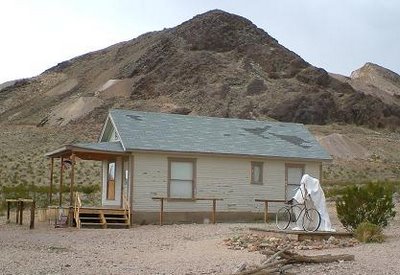
You could say I picked this assignment for Wordsmiths Unlimited on purpose. I took this picture because the scene spoke to me. I don't know what it said at the time, but it said something. I wanted to hear what it said to others. After much reflection, this is what I heard.


This is a work of fiction. Copyright © 2006 Rumba Creative. All Rights Reserved.
No portion of this work may be copied, retransmitted, reposted, duplicated,
or otherwise used without the express written approval of the author.


Lizard's Mirage

“Who are you talking to?”

“Just Dad.” Mom has the confused look on her face. I hold the handlebars of my bike, the seat resting against my hip. I know what she will say.

“Thomas, you know Daddy isn’t coming back. We’ve talked about it. Daddy is not coming back. Ever.”

“My name is not Thomas. It’s Lizard Boy. And Dad is here all the time. You just don’t want to see him.” Mom stands in the shady heat of the porch, her white skirt moving in the breeze like a ghost hung on the laundry line. Her face goes from sad to angry, then back to sad.

“Don’t take your bicycle up the hill. You’ll get hurt. Promise me, Thomas.”

“I promise,” I say, not really meaning it. “I won’t get hurt. Dad won’t let it.” Mom looks like she might cry. She opens the screen door. It bangs against the wall that Dad was painting. I watch her skirt flow out of the sun, into our house that isn’t the same any more.

I walk my bike up the hill. I love the hill. It has rocks and dirt and places in between where lizards hide. Dad loved the hill, too. We would walk up together, to watch a storm or a sunset. Sometimes we would just watch. Whatever we did, Dad always laughed while I climbed rocks, poking a stick in every hole and crack I found.

“You are a lizard, aren’t you my boy?” he would say. And I would smile and say “Yes, Dad. I am Lizard Boy!” The hill was the place we saw things and talked about things. When night came, we crawled back down to our house like lizards tired from the sun.

Today is the first time I climb the hill by myself. From the top I see everything. I see our house. I see rocks and sky. I see the whole world. I remember Dad saying never tell a lie. I remember Dad saying he would always watch over me.

I push the pedals of my bike, aiming the front wheel down the rocky slope. I feel the world rise up to meet me. I feel the wind in my face. I hear Dad whisper.

Sunday, September 3

Savings Account

If you haven't already, go to Wordsmiths Unlimited, a joint venture of Tiff and me. This is my entry for the inaugural exercise, inspired by the photo submitted. If you missed it this time, PLEASE stay tuned and submit your entry next month. No fame, no ass kissing, no prizes. It's just like life! What more could you ask?

This is a work of fiction. Copyright © 2006 Rumba Creative. All Rights Reserved.
No portion of this work may be copied, retransmitted, reposted, duplicated,
or otherwise used without the express written approval of the author.


Savings Account


"Shake the girl's hand, Varya."

“Tip your hat, Varya.”

"Give me the coin, Varya."

She hated Piotr.

Varya licked her bruised and cut feet, listened to his sleeping mind relive vodka and females. She couldn’t shake his thoughts, even when she covered her head with her thin blanket. Resigned to another sleepless night, she hid her stolen slips of paper in the folds of her clothing, and stretched as far as the wire cage would allow. Tomorrow she would spend hours on a hot sidewalk, feeding Piotr’s greed and lust. For now, Varya could do nothing but obey.

The morning sun warmed Nevsky railway station, setting pigeons to flight. The tourist season made the dusty corner a favorite of Piotr’s. She twirled to the music of his old record player, accepting coins from tourists, kissing knuckles with feigned appreciation. Every exchange transmitted their thoughts, enchanted, annoyed, indifferent.

“Say thank you to the gentleman, Varya,” said Piotr.

She assumed her cutest expression, climbed a red-faced man’s arm, and wrapped her thin arms around his neck. She patted his collar, his mustache, his pockets.

“What a charming animal!” The man lowered his arm with a chuckle, scratched her head, and walked away.

“Give it to me, Varya.” Perched on Piotr’s shoulder, she handed over the red-faced man’s billfold. Slips of paper peeked out from the leather. “Good girl, Varya, we shall celebrate tonight!” His thoughts were the empty echoes of a liar. He would celebrate, and she would munch a mushy potato in the dark, dreading the return of his sick drunken thoughts. Piotr didn’t know she stole one last paper slip for herself, and that was some consolation.

The long afternoon passed with laughter and copper coins. Twice she was photographed on a child’s head. As always, it was an endless parade of faces and fingers she had never seen, would never see again. Toward sunset, her stomach empty, her tongue dry, her muscles cramped, the man in the overcoat finally appeared.

“Hello again, sir! You are becoming our best customer! Give him a hug, Varya.”

Varya didn’t dare vary the game. She nuzzled the man’s neck, listening for an unspoken confirmation, and heard what she hoped. It would work! She kissed his ear, played with his overcoat pockets. With a grunt, the man in the overcoat gave her a coin and melted into the crowd.

“Give it to me Varya.” Other than the coin, she had nothing to give. Piotr cursed.

The man in the overcoat was gone, but Varya felt him counting the slips of paper she had stashed in his pocket. She felt his sick glee, his calculation of when, where, and how. The plan would work, she thought. If it did not, she was patient. She could choose another and try again.

Diversion, stealth, cunning: Piotr had taught her many things. Slavery used the same weapons, Varya had learned. Soon, very soon, Piotr would learn it, too.
Friday, August 25

Under A Puzzled Sky

Another writing contest, this time 250 words or less. This is much harder than it sounds, as careful placement of few words, and ruthless editing, is required. I leave it to you to decide if I was successful.

This is a work of fiction. Copyright © 2006 Rumba Creative. All Rights Reserved.
No portion of this work may be copied, retransmitted, reposted, duplicated,
or otherwise used without the express written approval of the author.


Under a Puzzled Sky

He really thought she would be the one, this time.

It was a mackerel sky, his late father would have called it. The clouds smeared and shifted moonlight into confusing shadows. He stared up from a stand of yellow pines, turning his thoughts over and over again without the distractions of the daylight world. There was a scent of approaching autumn on the wind, overlaid with the warm, decaying smell of forest duff. It was times like this when his mind asked the most questions.

He never could figure out what marked him as strange. As a child he had made no friends. It was no different now. Everyone in town knew him, but no one invited him anywhere. He worked alone, walked alone, fished alone, lived painfully alone. Women chanced upon him from time to infrequent time, but it always ended the same. It’s not you, they would say, It’s me. Which meant it really was him. Weird peculiar oddball him.

Why did everything always feel so wrong? Was there nothing but frustration and struggle? Did the world not understand him, or did he not understand the world? The world didn’t answer. There was only the melancholy thrum of frogs, the lamentations of crickets to a dying summer.

He really thought she would be the one, this time.

This time, at least, he had found a partial solution. Turning back to his work, he dumped her body in the pit and covered his questions with dirt.

Wednesday, August 2

Time Assassins, Inc.

This is my first attempt at a writing "game." The idea is to propose a subject and let others write a short story about it. It's an idea I've toyed with for some time, but someone(s) less lazy have already run with it, using pictures as the subject. This week's subject is from Tiff, who has been playing the game with Hyperion, et al.


This is a work of fiction. Copyright © 2006 Rumba Creative. All Rights Reserved.
No portion of this work may be copied, retransmitted, reposted, duplicated,
or otherwise used without the express written approval of the author.


Time Assassins, Inc.

“So what’s the assignment this time?” Wraith folded herself into an overstuffed chair, tucking her feet between the cushions. Behind the oak desk, Boss darted a furtive and appreciative glance at TAI's top agent. Wraith returned the look with indifference. Boss coughed, flipped the desk screen toward her.

“A routine job." He tapped the screen. “This is Doctor Archibald Preston, Professor of Experimental Physics, Cromwell University, circa 1948. What you see is the beginning of unlimited energy via temporal borrowing."

"You can't be serious. It looks like a giant robot vagina."

"Hm-hrrm.” Boss snugged his tie against his throat. “Well. Great inventions start small. The steam train started by watching a tea kettle." He averted his eyes as Wraith shifted. Just to spite him, she changed her position, taking advantage of the afternoon sun streaming through the window.

"So what's the job?" she asked, enjoying his discomfort.

"Standard termination. If Preston is allowed to complete his research, temporal energy borrowing will render our time untenable." Boss tossed a thick envelope toward her. "Here is everything you need. Clothing requisition, retroactive visitation warrant, appropriate currency. Good luck."


* * * * *

The assignment was no challenge for a seasoned time assassin. It was easy to charm the male authorities. A giggle here, a kiss there, Wraith found maneuvering the 1950’s no trouble. It was a simple matter to acquire a hotel room near the physics symposium. It was simpler yet to don a uniform, carry a tray, flirt the wait staff into complacency, and deliver the fatal needle to Doctor Preston’s neck. Before the good professor’s spasms could attract attention, Wraith was on the street. She pressed the embedded recall in her wrist.

* * * * *

"Well done." Wraith grasped at the bubble that was reality, tried to force her mind back to true time. "Bring her to my office," said the voice she thought she should know. She was shoved and dragged while her brain assimilated her being with her surroundings. She was deposited on a hard chair in a dark room. After a few moments, clarity returned.

"Welcome back," said Boss. "You took longer to return than expected." His tone was unfamiliar, cold, uncaring, offensive.

"How is that my responsibility? Don't talk to me like that. You know how hard it is." Wraith shook the last blurs from her head and looked about her. There was no soft chair, only hard plastic. The wooden desk was gone, replaced with a square of grey metal. The window admitted no sunlight, only a view of yellow smoke. Boss smiled and walked behind her.

"You have done well." He whispered close, licking her ear. Wraith shuddered, recoiled. She leapt to the door, found it locked.

"Get away. What the hell is wrong with you? "

"You were always my favorite." Boss smirked and slipped a hand down her blouse. "The part you play changes every time. But you can't change time, can you?"

Saturday, April 1

Caged Curiosity

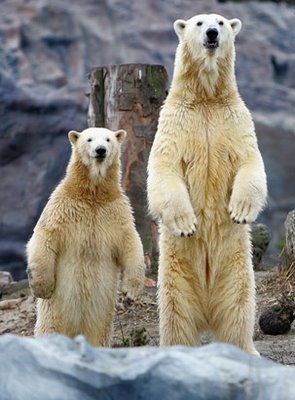
"What are they doing, Momma?"

"They're touching faces, son."

"Why?"

"You know how Rosie and Pete touch noses sometimes?"

"Yeah, like Uncle Bruce and Stevie?"

"Um, well sort of. We'll talk about your uncle when you're older. But remember after all the nose touching, Rosie had your cub-cousin Rolly?"

"Yes."

"The dumbthings face-touching is like that."

"Are they going to have a cub-cousin? Can I watch?"

"Yes. No. I mean, you can't watch, and they already have one. See that rolling thing with the screaming pink thing in it?"

"Yes, Momma."


"That's the cub."

"THAT? It looks stupid."

"Yes it does. It wouldn't last a day on the ice."

"Tell me about the ice again, Momma."

"It's cold and it feels good. Not like here. And there are good things to find and eat."

"Things to eat like the pink cub?"

"No, things that are quiet and smell good. That taste like fat and blood."

"I'm hungry, Momma."

"I know. So am I. Let's go leave our markings, and hope they bring a walrus."

"What's a 'walrus'?"

"Never mind, son."

Friday, September 9

Rule Number Seven

This is a work of fiction. Copyright © 2005 Rumba Creative. All Rights Reserved.
No portion of this work may be copied, retransmitted, reposted, duplicated,
or otherwise used without the express written approval of the author.


Rule Number Seven


“Are you still playing that stupid game?”

“It’s not a stupid game. It’s very hard.”

“It looks pretty stupid when a grown man plays with dolls.”

“They’re not dolls. They’re action figures.”

Her smirk was evidence of her disbelief. He continued to move his finger across the playing field. She stood over his shoulder. It was impossible to play strategy when she was looking, scrutinizing his every move, and forming an opinion without knowing the rules.

“So, are you winning?”

“Kronos isn’t feeling well. I think his son may take his place, but he’s a long way from being a threat. So I’m doing pretty well in the eastern Mediterranean and Egypt.”

“That’s not what Isis says.”

“Forget Isis. She’s not playing. Osiris is making a play, but I am going beat him. He thinks it’s all about cities and power. I’m playing strategy.”

“So what? Baal says Allah is playing strategy, too. Good strategy.”

“Allah just got in the game. He hasn’t even made up his rule book yet, and he wants to ally himself with me. Can you leave me alone now?” He turned his back to her, hoping she couldn’t see the game matrix. No matter what he accomplished, it wasn’t ever enough. Honey, do this. We never talk. You don’t take me anywhere. Where did she think this cushy palace came from? So now he tried to relax and play his game, but she had to try and kill it. Sometimes ignoring her worked. Sometimes it didn’t. This was shaping up to be a didn’t.

“Listen to me, mister. I’ve had it. I was talking to Drvaspa..”

Oh, damn. There it was.

“I can’t even play cards with the girls any more. It’s humiliating!”

“Aw, honey. We’ve been through this. Inari was just a passing phase. A moment of weakness. I know better now. How many times can I say I’m sorry?”

“Inari! What about Ishtar? Was she a passing phase? Or Kuan Yin? Was she a moment of weakness? Or Parvati? Do I have to mention Parvati? That sexy bendable little tramp? It’s all fine for you to play your dumb little game. But I can’t get together with the girls without the snickering and the whispers behind my back. And I can see behind me!”

The game was ruined now. It was obvious well placed flatteries, frivolous gifts, and huge favor repayments were in his very near future. He could control almost anything. Almost. Just not her.

“Please don’t bring up Parvati. Shiva is already winning because of south Asia, I don’t need him angry with me.” He said it with disapproval, but knew he was already doomed. “All right. What do you want from me? It’s my turn and my piece is waiting.”

She stood, hands on hips, with that look. The look that only a woman could give. The look that made everything male in the universe shrivel and cower. He felt his omnipotence slither away to hide in some place even he couldn’t find. Good thing he wasn’t playing the game against her. Looking up from beneath his lowered brow, he saw the pursed lips of judgment.

“This is what I want. This is what you will do. You didn’t even mention me in the first chapter of your rule book, for chrisakes. So I will make a rule for your game now. You will write into it your everlasting shame and dedication. You will promise in your game that you will never repeat your humiliation of me with other women. If you don’t, I shall surely wipe you, your friends, and your stupid game from the heavens. Understand?”

With that, she stalked out. She did have a great wiggle in her walkaway. How could he stay mad? With a sigh, he returned to his game. He knew what he had to do. He would write in the rule she demanded. Just to spite her, though, he would put it after all the stuff that made him important. After all the rules to worship him, and keep his name holy.

With a sweep of his finger, he erased the rock, and inserted: “VII. Thou Shalt Not Commit Adultery.”

Sunday, August 7

Indirective

This is a work of fiction. Copyright © 2005 Rumba Creative. All Rights Reserved.
No portion of this work may be copied, retransmitted, reposted, duplicated,
or otherwise used without the express written approval of the author.

Indirective

There was but one directive. Although she could not know it, it was the overriding necessity of her mother, and her mother’s mother, and so on into the depths of time unacknowledged and unknown. One thing, and one thing only, was the point of her existence. To consume was important, to understand your shoal mates was important, to understand each rock and each phase of the sun and moon was imperative. All this she knew instinctively. Yet there was but one directive: multiply.

She wriggled through the tough eggshell that had encased her, allowing the water to carry her beneath the protection of the smooth stones in the nursery cove. She absorbed the sack from her abdomen, easing her stomach, but not her tongue. Within days, she was chasing the minute shrimp that shared her stony lake bottom. It was good to stalk them, to watch them, unaware of her presence, until her strike and the pleasant wriggling feeling in her gullet. When small crustaceans were unavailable, she feasted on the remains of her unborn brothers and sisters.

Soon her fins were strong enough to venture into the heights of the water column that splashed the suns rays into kaleidoscope patterns. With her relatives she learned to ride these shifting shadows, to hide herself and confuse her enemies. Feel the motion of your brethren! Anticipate the movement of the currents! Know your place and grow strong! Only then would she be worthy of passing on her skills to the next generation.

For months she swam, and gulped, and lived among the thousands of her kind, swirling among the shafts of light, hiding among the rocks at night, avoiding the larger of her kind, and devouring the smaller. Her strength, and those of her kind, was the mass and confusion of the shoal. It was the time of testing. It weeded out the weak, and made the strong stronger. Only the remaining few would survive to multiply, perpetuating the shoals that darkened the wide, warm lake that was their ancestral home.

On the third full moon after the warmest of the waters, the shoal began to fragment. The males who, until now, had mostly escaped her attention, left the safety of numbers and headed to shallow waters. She and her sisters migrated to the deeper, colder areas of the lake, searching out the minnows grown lazy on the free-floating algae and invertebrates blooming in the warm sun of the lake’s surface. For perhaps a half moon they gorged themselves on this field of plenty. Their appetites were insatiable, and they themselves grew fat on the tasty morsels and the unfertilized life growing within them.

On a morning bright with the receding sun, her hunger waned. For a while she and her sisters lolled in the rippling shafts. Within hours, the directive was upon them: Multiply!

With the fever of the annual cycle, they sought out the warmer shallows of the shore, reuniting with the males. She searched the submerged rocks, deadwood, and castoffs of the surface world for the perfect place. The males were dark with aggression and lust, darting at her, teasing her, locking jaws with their rivals. None would do.

In a cove shallow and warm, she saw him. The charcoal stripes on his sides and the flush in his gills were in defiance of predators. His fins rotated with confidence and vitality. His shuddering dance and caress against her scales were irresistible. The depression in the sand, surrounded by carefully placed pebbles, was perfect. The surges within her were undeniable.

In unison, they darted to toward the surface, beginning the intertwining of the mating ritual. Before the dash back to the safety of the sandy bottom, the sky fell in on her. She was hauled into a dry suffocating place where the sun burned her eyes to blindness, and her tail flailed helplessly against an insubstantial atmosphere. Caught in a nasty abrasive mesh for which she had no comparable experience, she gasped and died.

The directive to multiply would die with her.

* * * * *

“And they say unto him, ‘We have here but five loaves, and two fishes.’ He said, ‘Bring them hither to me.’ And he commanded the multitude to sit down on the grass, and took the five loaves, and the two fishes, and looking up to heaven, he blessed, and brake, and gave the loaves to his disciples, and the disciples to the multitude. And they did all eat, and were filled: and they took up of the fragments that remained twelve baskets full. And they that had eaten were about five thousand men, beside women and children.”